A paver-sealer problem is easiest to correct when it is diagnosed by symptom, timing, and cause—not by appearance alone. White or cloudy areas, bubbles, streaks, roller marks, lap lines, peeling, tire marks, fading, and a slippery finish can look related while requiring very different repairs. Applying another coat before identifying the failure mechanism can lock in moisture, increase film thickness, reduce traction, or make removal more difficult.
This troubleshooting hub gives homeowners and contractors a disciplined way to evaluate a sealed surface, decide whether the defect is cosmetic or functional, and choose the least aggressive correction that is likely to work. For application-specific defects, continue to the linked guides on streaks, bubbles, and lap lines, uneven sealer and roller marks, and fading and weather exposure.
Start With the Four Facts That Control the Repair
- What system is on the surface? Record the product name, chemistry, number of coats, application rate, and whether an older coating was present. Water-based acrylic, solvent-based acrylic, one-component urethane, two-component urethane, and penetrating treatments do not respond to the same repair solvents or recoating methods.
- When did the symptom appear? A defect visible during application usually points to technique, coverage, or working time. A defect appearing after rain or irrigation often points to moisture. A problem that develops after vehicle traffic or months of UV exposure may indicate cure, compatibility, film selection, or maintenance.
- Where is it located? Compare shaded and sunny areas, low joints and high paver faces, tire paths and pedestrian zones, edges and open fields, and areas near sprinklers or pools. The pattern often reveals the cause.
- Is the coating bonded? A sound but uneven film may be repairable by cleaning, abrading, or applying a compatible correction coat. A soft, peeling, delaminated, or heavily contaminated film usually requires more substantial removal.
Before testing a correction, review the manufacturer’s current technical data and perform a small, inconspicuous test area. The goal is to confirm compatibility and appearance before committing the entire project.
Paver-Sealer Symptom and Cause Guide
| Visible symptom | Common causes to investigate | First safe step |
|---|---|---|
| White, milky, or cloudy film | Moisture below or within the coating, incompatible old sealer, excessive film build, or blushing during cure | Stop recoating, let the surface dry, document the pattern, and test compatibility |
| Bubbles or pinholes | Outgassing, trapped air, overworking, heat, direct sun, excessive film thickness, or moisture | Allow full cure, determine whether bubbles are surface-level or through-film, then test a localized correction |
| Streaks, lap lines, or roller marks | Uneven coverage, loss of wet edge, wrong applicator, inconsistent pressure, wind, heat, or partial cure | Do not spot-coat randomly; evaluate the entire application section and sheen |
| Too slippery | High film build, smooth substrate, excessive gloss, missing or insufficient traction additive, or contamination | Restrict traffic if necessary and test a compatible traction-corrective system |
| Dark tire marks or hot-tire pickup | Rubber transfer, uncured or softened film, incompatible coating, excess film, or chemical attack | Determine whether the mark is on top of the film or whether the film has lifted |
| Peeling or flaking | Poor adhesion, trapped contamination, incompatible old sealer, moisture pressure, overapplication, or substrate movement | Map the failed and sound areas; avoid coating over loose edges |
| Premature fading or dulling | UV exposure, abrasion, underapplication, incompatible maintenance chemicals, weak color enhancement, or coating erosion | Clean a test area and distinguish surface soil from actual film loss |
Why Is My Paver Sealer Too Slippery?
Traction is a system property. It depends on the original paver texture, coating thickness, finish, water exposure, contaminants, slope, footwear, and any compatible traction additive. A product described as suitable for exterior use can still feel slick if it is applied too heavily over a dense or smooth surface. Pool decks, steps, sloped walks, and constantly wet zones deserve a field sample under realistic wet conditions.
Do not assume that adding loose sand to a finished surface is a durable correction. A repair must be compatible with the existing coating and must distribute the traction media uniformly. Random spot application can create visible patches and inconsistent grip. If the surface presents an immediate slip risk, restrict access until a qualified correction has cured and been evaluated.
Are Tire Marks a Stain or a Coating Failure?
Rubber transfer usually sits on top of a sound film. Hot-tire pickup is different: the tire softens or bonds to the coating and pulls part of the film from the surface. Inspect the mark at the edge. If the sheen and film remain continuous, begin with the mildest cleaner permitted by the coating manufacturer. If the film is wrinkled, soft, torn, or missing, cleaning alone will not restore it.
Vehicle areas need a coating selected for traffic, heat, chemical exposure, and the underlying surface—not simply for gloss. Cure time matters as much as dry-to-touch time. A driveway can look dry while the film has not reached the stage required for vehicle loading. Follow the product’s current return-to-service guidance and extend the window when cool, damp, shaded, or poorly ventilated conditions slow cure.
A Practical Diagnostic Sequence
- Photograph the whole area and close-ups. Include dry and damp conditions, edges, joints, traffic paths, shaded areas, and drainage lows.
- Protect the evidence. Do not pressure wash aggressively, apply solvents, or add sealer until the coating and symptom have been identified.
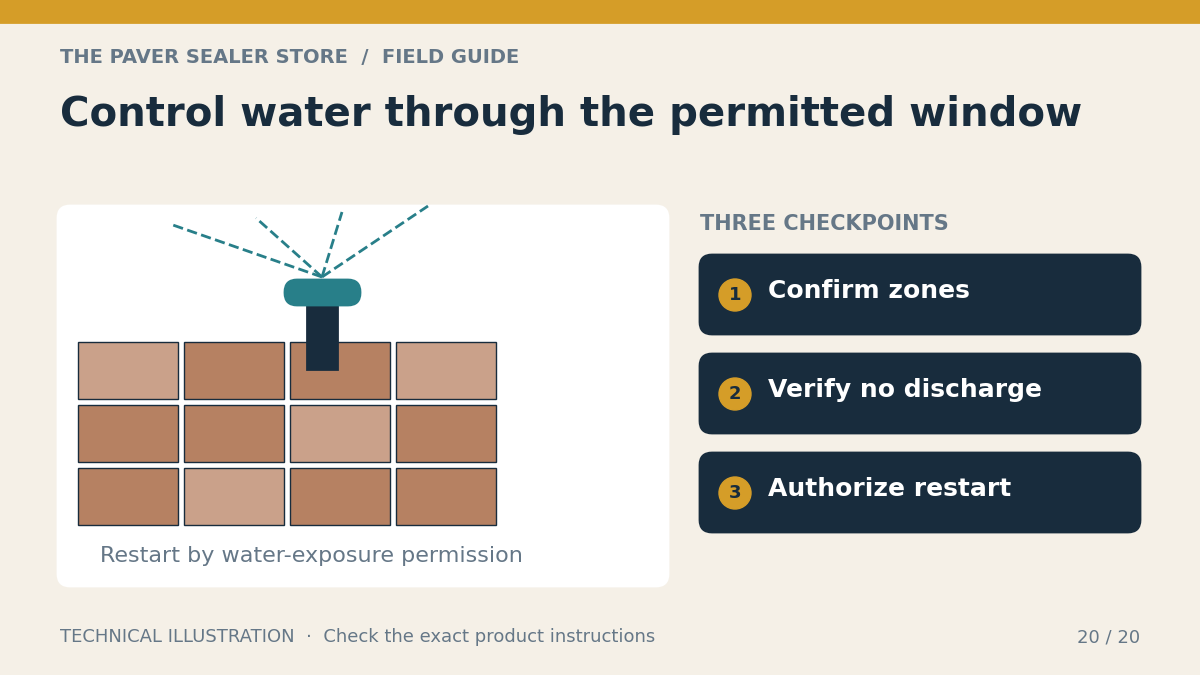
- Check drainage and moisture sources. Look for irrigation, recent rain, damp joint sand, efflorescence, leaking pool equipment, and moisture entering from adjacent soil.
- Perform a dry inspection. Note hardness, adhesion, tack, gloss, texture, and whether the problem follows applicator passes or paver boundaries.
- Clean a small control area. Use the mildest compatible cleaner so soil, tire residue, or maintenance film is not mistaken for coating failure.
- Run one controlled repair test. Choose an inconspicuous section that includes both defective and sound film. Record the product, dilution, method, dwell time, weather, and result.
- Evaluate after full cure. A correction should be judged for appearance, adhesion, traction, and uniformity—not just how it looks while wet.
When a Recoat Is Appropriate
A correction coat can be appropriate when the existing film is clean, dry, compatible, well bonded, and within the manufacturer’s recoat requirements. It may help unify minor sheen variation or a controlled application defect. It is not a substitute for removing loose coating, correcting moisture, or cleaning contamination. Recoating a soft or delaminating film transfers the failure into the new layer.
Compatibility is especially important when the original product is unknown. “Clear sealer” is not a chemistry. Even products that look similar may differ in resin, carrier, solids, and recoat behavior. If the existing system cannot be positively identified, a small adhesion and appearance test is essential. Review the complete paver-sealer selection guide before changing chemistry.
When Removal Is the Better Repair
Removal is commonly necessary when coating is peeling over broad areas, chemically softened, incompatible with the substrate, contaminated beneath the film, or built up through repeated heavy applications. Removal may also be required when appearance problems are distributed through multiple layers rather than limited to the surface.
Stripping is a controlled project, not a stronger version of cleaning. The correct remover, dwell time, containment, agitation, recovery, rinse process, and substrate protection depend on the coating and site. Test first and protect plants, pool water, walls, metals, drains, and adjacent coatings. After removal, allow the pavers and joints to dry to the replacement sealer’s requirements before resealing.
How to Prevent the Same Failure
- Identify the substrate and every existing coating before product selection.
- Clean contamination rather than merely moving it deeper with uncontrolled pressure.
- Restore joint sand and remove loose material before sealing.
- Confirm the surface and joints meet the product’s moisture requirements.
- Use measured coverage instead of judging application rate by shine.
- Work in sections sized to maintain a wet edge under the actual temperature and wind.
- Use the specified applicator and avoid overworking material as it begins to set.
- Plan pedestrian and vehicle closure around full cure and return-to-service time.
- Build traction into the sample when sealing pool decks, steps, slopes, and wet areas.
For a start-to-finish procedure, use the paver-sealer application guide. If the project requires a new product system, compare professional options in the Paver Sealer Store catalog and follow the technical data for that exact product.
Frequently Asked Questions
Can I put another coat over cloudy or uneven sealer?
Only after the cause is known and the existing film is dry, clean, compatible, and bonded. Another coat can intensify cloudiness, trap moisture, or increase visible overlap if those conditions are not corrected first.
Will pressure washing remove bad paver sealer?
Pressure washing may remove loose flakes, but it is not a controlled method for removing a bonded coating. Excessive pressure can scar pavers, erode joints, and leave an irregular film that complicates recoating.
How long should I wait before deciding a sealer failed?
Use the manufacturer’s cure and return-to-service schedule, adjusted for actual site conditions. Cool temperatures, shade, high humidity, damp joints, and heavy film can extend cure. Immediate safety issues such as a slippery surface or soft film should be addressed by restricting traffic while the cause is evaluated.
What information should I provide when asking for technical help?
Provide product and batch information, substrate, old-coating history, preparation method, application rate, number of coats, applicator, weather, moisture conditions, cure time, traffic timing, cleaners used, and clear photographs. Those facts make a reliable diagnosis far more likely than a photo alone.