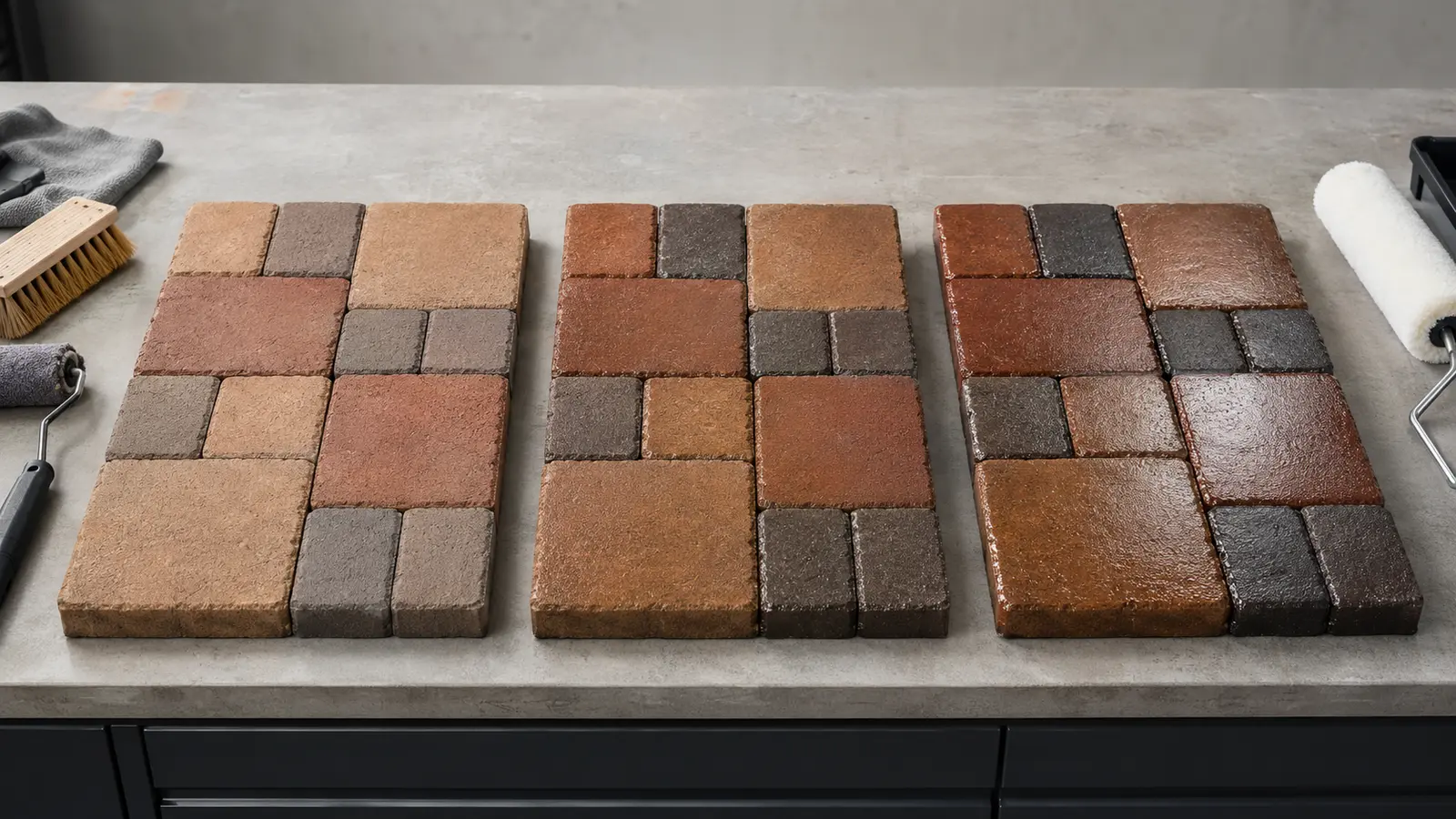
There is no single “best” paver sealer for every project. The correct choice depends on the surface, old coating, desired sheen, moisture conditions, traffic, joint-sand needs, and how the product will be applied. This comparison explains which type of sealer is best for the most common project goals and why a high-quality product can still fail when it is used in the wrong situation.
Best paver sealer by desired finish
| Desired result | Best system to evaluate | What to verify |
|---|---|---|
| Strongest glossy wet look | High-gloss film-forming urethane | Surface compatibility, coating condition, traction, and even thin-coat application |
| Color enhancement plus joint stabilization | Wet-look film-forming urethane designed for sand stabilization | Sand condition, damp-or-dry requirement, mixing, pot life, and weather window |
| Natural appearance | Penetrating or impregnating sealer | Approved substrate, absorption, breathability, and stain or water-repellency goal |
| Simple no-mix workflow | One-component urethane | Surface dryness, wet edge, coverage, cure protection, and storage instructions |
If the finish is still undecided, compare wet-look and natural-finish sealers. Use the surface and old-coating checks below before selecting a system.
Best high-gloss sealer: UltraGloss SX
UltraGloss SX is a single-component urethane designed to produce a high-gloss wet look on compatible pavers, brick, concrete, natural stone, and epoxy-floor topcoat applications. Because it does not require catalyst mixing, the installer can pour out the amount needed and return clean, uncontaminated material to the original pail.
- Best fit: owners who prioritize maximum gloss and contractors who want a no-mix urethane workflow.
- Why choose it: deep color enhancement, abrasion and stain resistance associated with urethane chemistry, and reduced mixed-material waste.
- Verify first: substrate approval, old-sealer compatibility, dryness, surface temperature, coat thickness, traction, and cure time.
A no-mix product is not a no-preparation product. Excessive film build, contamination, trapped moisture, or rolling back into material that has begun to set can create a poor finish. Follow the current product instructions and the high-gloss urethane application guide.
Best wet-look sealer for joint stabilization: Ultra Seal Classic Gloss
Ultra Seal Classic Gloss is a water-based, two-component urethane formulated for wet-look color enhancement and joint-sand stabilization. It is designed for application to properly prepared damp pavers, supporting same-day cleaning and sealing when the site conditions and technical instructions are followed.
- Best fit: paver driveways, patios, walkways, and pool-deck projects where richer color and stabilized joints are priorities.
- Why choose it: two-component cured coating performance, low-VOC water-based chemistry, and a workflow designed for damp pavers.
- Verify first: exact Part A/Part B procedure, pot life, sand type and level, surface dampness, standing water, weather, coverage, and recoat timing.
“Damp apply” does not mean wet, flooded, dirty, or weatherproof. Remove standing water, rinse away residue, protect the application from rain and irrigation, and follow the label. Read the wet-look paver sealer guide before starting.
Best natural-finish concrete sealer: Ultra Seal Eco Shield
Ultra Seal Eco Shield Dry Look Penetrating Concrete Sealer is designed for owners who want water repellency and protection without a glossy topical film. Penetrating chemistry is often the better fit when vapor movement, a natural appearance, or lower visual change matters more than color enhancement.
- Best fit: compatible concrete and masonry where a dry look is preferred.
- Why choose it: breathable water repellency, moisture and salt resistance, and minimal change to surface appearance.
- Verify first: substrate approval, absorption, surface profile, prior sealer, application rate, and removal of excess material.
Best sealer by surface and use
| Project | Usually start by evaluating | Do not overlook |
|---|---|---|
| Brick-paver driveway | Wet-look or high-gloss urethane | Hot tires, oil, turning traffic, old coating, and sand loss |
| Paver patio or walkway | Finish selected by appearance and maintenance goal | Furniture cure time, irrigation, shade, and wet traction |
| Pool deck | Compatible finish with traction plan | Standing water, slope, chemicals, barefoot use, and slip-resistant additive |
| Poured concrete | Penetrating or approved film-forming concrete system | Moisture, profile, curing compound, paint, and prior coating |
| Natural stone | Stone-approved impregnating or film-forming product | Density, mineral sensitivity, moisture, test-area color, and breathability |
| Commercial hardscape | System selected for traffic and maintenance access | Closures, cure protection, chemicals, abrasion, and future recoating |
Why acrylic and urethane are not interchangeable
Basic acrylic sealers can be economical and easy to recoat, but they generally do not provide the abrasion, stain, chemical, and hot-tire resistance expected from a properly selected urethane system. Urethane also demands disciplined preparation and application. Putting urethane over a weak, contaminated, or incompatible acrylic film does not strengthen the layer underneath.
Existing coating must be identified and tested. When it is peeling, whitening, soft, or unknown, stripping may be safer than recoating. Use the sealer troubleshooting guide to diagnose the condition before choosing a new product.
Five mistakes that make the “best” sealer fail
- Choosing by sheen alone: gloss does not prove compatibility, breathability, or durability.
- Ignoring old coating: the new layer is only as secure as the surface beneath it.
- Applying too much: heavy coats can trap air or moisture, slow cure, whiten, or show roller marks.
- Using the wrong weather window: heat, humidity, wind, dew, rain, and irrigation affect application and cure.
- Skipping the test area: a small cured test can reveal color, adhesion, texture, and traction before the full project is committed.
Best paver sealer FAQ
What is the longest-lasting paver sealer?
Service life depends on chemistry, preparation, coat build, sun, moisture, vehicle traffic, cleaners, and maintenance. A urethane system can outperform a basic acrylic, but only when it is compatible and correctly installed.
What is the best paver sealer for Florida?
Florida projects must account for strong ultraviolet exposure, heat, humidity, heavy rain, irrigation, biological growth, and moisture moving through the base. Choose by surface and finish, then confirm the product’s moisture and weather requirements. “Made for Florida” is not a substitute for those checks.
Is water-based sealer weaker than solvent-based sealer?
No. The carrier alone does not determine performance. Resin type, solids, crosslinking, adhesion, coat build, surface preparation, and cure conditions all matter. Ultra Seal Classic Gloss is a water-based two-component urethane, which is a different system from a basic water-based acrylic.
Should a homeowner apply the sealer?
A prepared homeowner can handle some clean, uncoated, straightforward projects. Old sealer, repairs, stripping, multiple surfaces, tight weather, large square footage, or two-component timing may justify a professional. Use the homeowner DIY-versus-professional guide to decide.
Choose by project facts, not by a universal ranking. Compare the current sealing products, confirm the label and technical data, and test the selected system on the actual surface before full application.
Check the existing surface before selecting a sealer
First identify every material in the project: concrete pavers, clay brick, poured concrete, exposed aggregate, or natural stone may absorb and react differently. Check the current product instructions for each substrate. On mixed surfaces, test each material separately and let the sample cure before judging color, adhesion, and wet traction.
Inspect joints, edges, low areas, shade, and tire paths for an existing film. Uneven sheen, peeling, whitening, soft patches, trapped dirt, and tire pickup point to a coating that needs diagnosis. Water beading is a clue, but it does not identify the old chemistry. Confirm compatibility with the proposed system on a prepared test area; if the coating is failing or unknown, assess removal before adding another layer. See the sealer troubleshooting guide.
Preparation checklist before applying the chosen system
- Confirm the product approves the surface, existing coating, and intended traffic and finish.
- Clean stains, biological growth, residue, and loose sand; repair damaged areas and allow repairs to cure as instructed.
- Check joint-sand type and level if stabilization is part of the goal.
- Follow the product’s exact dry or damp-surface requirement, and remove standing water.
- Plan around surface temperature, rain, dew, irrigation, wind, pot life, and the full cure period.
- Apply a small test area and inspect its cured color, sheen, adhesion, and traction before covering the project.
Focused field guides
Use these guides for specific questions within this system.
- Porcelain Paver Borders: Keep Concrete and Stone Sealers Off Unapproved Surfaces
- Concrete Pavers With Natural Stone Borders: Plan Two Substrates in One Sealing Job
- Factory-Treated Pavers: Verify Aftermarket Sealer Approval Before Buying
- Reclaimed Brick Pavers: Assess Unknown History Before Choosing a Sealer