Efflorescence on pavers is a surface deposit of soluble salts left behind when moisture moves through concrete, brick, mortar, or another porous material and then evaporates. It usually appears as white powder, haze, crystals, or irregular light patches. The deposit is often cosmetic, but it is important before sealing because it can distort color, signal active moisture movement, return after cleaning, or be confused with whitening inside an existing sealer.
This is the diagnosis hub for efflorescence. Use the rust, irrigation stain, and efflorescence removal guide when selecting a cleaner, the surface-preparation hub before sealing, and the professional-cleaner comparison for light deposits, broad pre-seal cleaning, and heavy mineral buildup.
How Efflorescence Forms
- Water enters or is already present in pavers, masonry, mortar, bedding, base material, a wall, or the concrete assembly.
- The water dissolves salts that exist in cementitious materials, soil, fill, mortar, water, or nearby sources.
- Moisture moves toward an exposed surface through pores, joints, cracks, edges, or pressure differences.
- Water evaporates at the face and leaves mineral crystals behind.
- Repeated wetting and drying can move more salts and recreate the deposit after cleaning.
Efflorescence is not “water trapped in the white powder.” It is evidence of a water-and-salt pathway. Cleaning removes what reached the surface; prevention requires understanding whether that pathway is temporary—such as early movement from new masonry—or ongoing because of drainage, irrigation, groundwater, wall moisture, or repeated pool splash.
Efflorescence vs Other White Paver Problems
| Condition | Typical clues | Correct next step |
|---|---|---|
| Efflorescence | Powdery or crystalline, may brush off, often returns after wet/dry cycles, follows joints or moisture paths | Diagnose water source, dry-brush or test a compatible mineral-cleaning process, then monitor. |
| Sealer whitening or haze | White condition is inside or beneath a film, may be glossy or cloudy, often follows sealing or rain | Use the cloudy-sealer diagnosis guide; stripping or coating repair may be required. |
| Hard-water or calcium scale | Crusty deposit near pool coping, sprinklers, fountains, walls, or evaporation lines | Identify the mineral and use a compatible specialty remover under its current directions. |
| Mortar or grout residue | Localized smear near new joints, edges, installation work, or repairs | Confirm the material and cure before choosing a masonry-cleaning process. |
| Mold, algae, or biological growth | Green, black, gray, or white organic film associated with shade and persistent moisture | Use a compatible biological-cleaning and moisture-control procedure. |
| Surface wear or color loss | Light area is hard, not removable, and follows traffic, pressure-washer marks, etching, or faded pigment | Cleaning will not restore removed material; evaluate repair, tint, or finish options. |
A simple brush test can provide a clue but is not a complete diagnosis. Photograph the condition before and after rain, during drying, and after brushing. Note whether it is above, below, or within sealer and whether the same pattern repeats.
Common Causes on Paver Installations
- New concrete or masonry: available construction moisture and salts can migrate during early exposure.
- Irrigation overspray: repeated wetting and water-borne minerals create a recurring edge or sprinkler pattern.
- Poor drainage: low spots, blocked drains, compacted or unsuitable base conditions, and surrounding grade keep the assembly wet.
- Downspouts and roof runoff: concentrated water repeatedly enters one band of pavers or a wall base.
- Pool and fountain splash: evaporation leaves water-borne minerals and keeps joints wet.
- Walls, planters, and raised beds: water moves through masonry or soil and exits at the visible face.
- Joint and edge conditions: open joints, failed borders, saturated bedding, and damaged drainage create preferred moisture paths.
The source can be outside the visible white area. A deposit at the edge of a patio may come from grade or irrigation several feet away. Cleaning should follow a water-path survey rather than the deposit outline alone.
When to Wait and Monitor
Light, dry powder on new unsealed pavers may weather or reappear as the installation cycles. Immediate aggressive cleaning can be wasteful if the salt source is still active. Confirm the paver and installation manufacturer’s cure and cleaning guidance, dry-brush a small area, and monitor after rain and irrigation. Do not use a fixed waiting period from another product or project.
Waiting does not mean sealing over it. Delay the coating when visible salts are present, moisture is unresolved, or the cleaned test rapidly blooms again. The job is ready when the surface and moisture condition meet the selected sealer’s current specification and the representative test remains acceptable.
Efflorescence Removal Sequence
- Document the pattern. Record weather, irrigation, drainage, new work, walls, pool splash, existing sealer, and when the white condition changes.
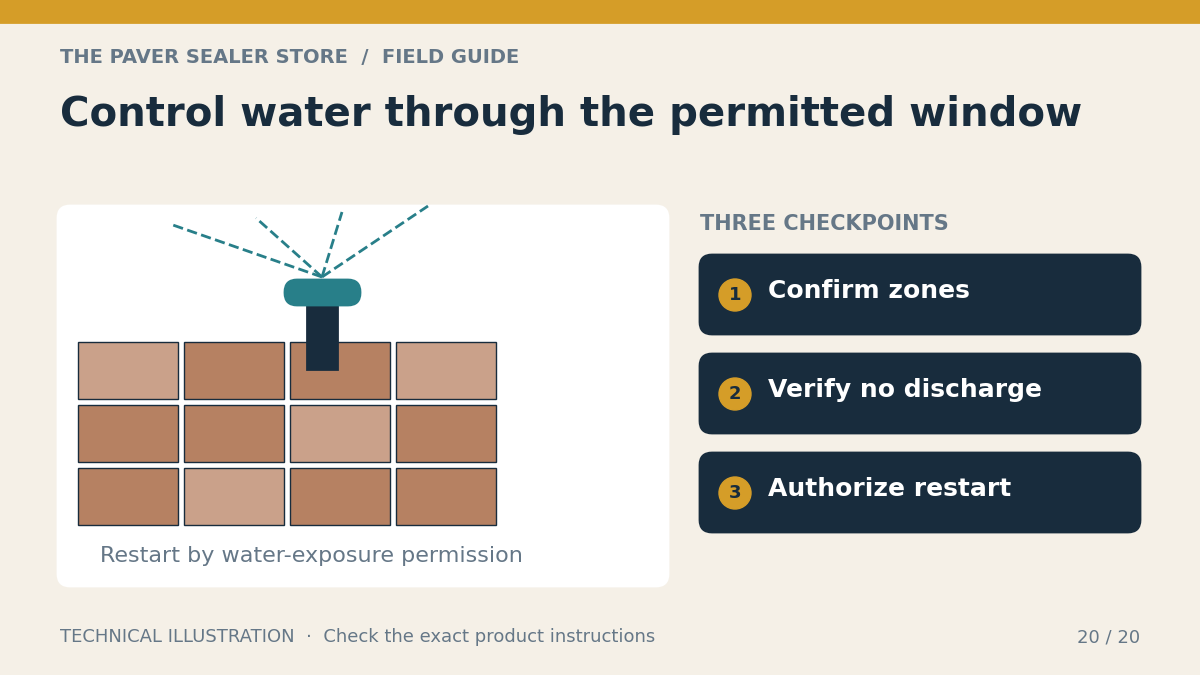
- Correct controllable water sources. Adjust irrigation, extend downspouts, clear drains, repair leaks, improve grade where appropriate, and address low areas or wall moisture.
- Test dry removal. On loose surface salts, use a substrate-safe dry brush or vacuum and collect the deposit rather than washing it back into the pores.
- Test a compatible cleaner when needed. Choose between broad pre-seal preparation and a specialty mineral remover based on deposit severity, substrate, coating, and current label.
- Protect and measure. Isolate glass, metals, plants, pools, drains, adjacent finishes, and runoff; measure dilution, area, temperature, and dwell.
- Apply and rinse exactly as specified. Keep the cleaner controlled and do not allow residue or slurry to dry.
- Dry and monitor. Inspect color, texture, joints, residue, and whether salt reappears through a representative wet/dry cycle.
- Complete a sealer test. Verify appearance, moisture compatibility, cure, adhesion, and traction before full application.
Using Ultimate Surface Prep
Ultra Seal Ultimate Surface Prep is currently listed for pre-seal cleaning and for efflorescence, rust, and organic staining on specified permeable materials. Its online procedure calls for one part product to ten parts water, two to three minutes of dwell, pressure washing, and thorough rinsing. Heavy staining may need another application, and the page warns against glass contact.
Use the current label and safety data and follow the measured application guide. If the deposit is heavy calcium or longstanding mineral buildup, compare a specialty F9-type product using the cleaner-selection matrix. Never increase acid strength or combine products to compensate for a wrong diagnosis.
Sealing After Efflorescence Removal
Sealer can reduce liquid-water entry from the exposed face, but it cannot correct every source below, behind, or beside the pavers. A film-forming finish may make any remaining white deposit more noticeable, and active moisture can contribute to haze or whitening. A penetrating sealer may remain more breathable, but it still requires a clean, compatible surface and does not stop water moving from an unresolved source.
- No visible powder, crystal, cleaner residue, slurry, or loose material remains.
- The deposit does not rapidly return during the monitored dry cycle.
- Drainage, irrigation, leaks, and other controllable sources are corrected.
- The surface meets the sealer’s dry or approved damp condition and weather window.
- The test area develops acceptable color, gloss, cure, adhesion, and traction.
Review the paver-sealer moisture and curing guide before choosing application timing. Damp-apply capability is product-specific and does not authorize coating over active salt movement or standing water.
Efflorescence FAQ
Does efflorescence damage pavers?
The visible deposit is often primarily an appearance issue, but the moisture source or an aggressive removal process can affect the installation. Diagnose the assembly rather than judging only the powder.
Can efflorescence return after cleaning?
Yes. If water continues dissolving and transporting available salts, a new deposit can form. Source control and monitoring are part of the repair.
Can I pressure wash it away?
Loose deposits may be removed, but water can also move salts back into pores and excessive pressure can damage the paver face and joints. Test the least damaging complete process and collect residue.
Can I seal over a small white patch?
Do not seal until the patch is diagnosed, removed or otherwise resolved, and the moisture condition passes. A small patch can become a permanent visual defect beneath a color-enhancing film.
Best practice: treat efflorescence as evidence. Record when it appears, trace the water path, use the least damaging compatible removal method, monitor the dry result, and approve the sealer only after the complete test passes.