Part of the How to Seal Patio Pavers guide.
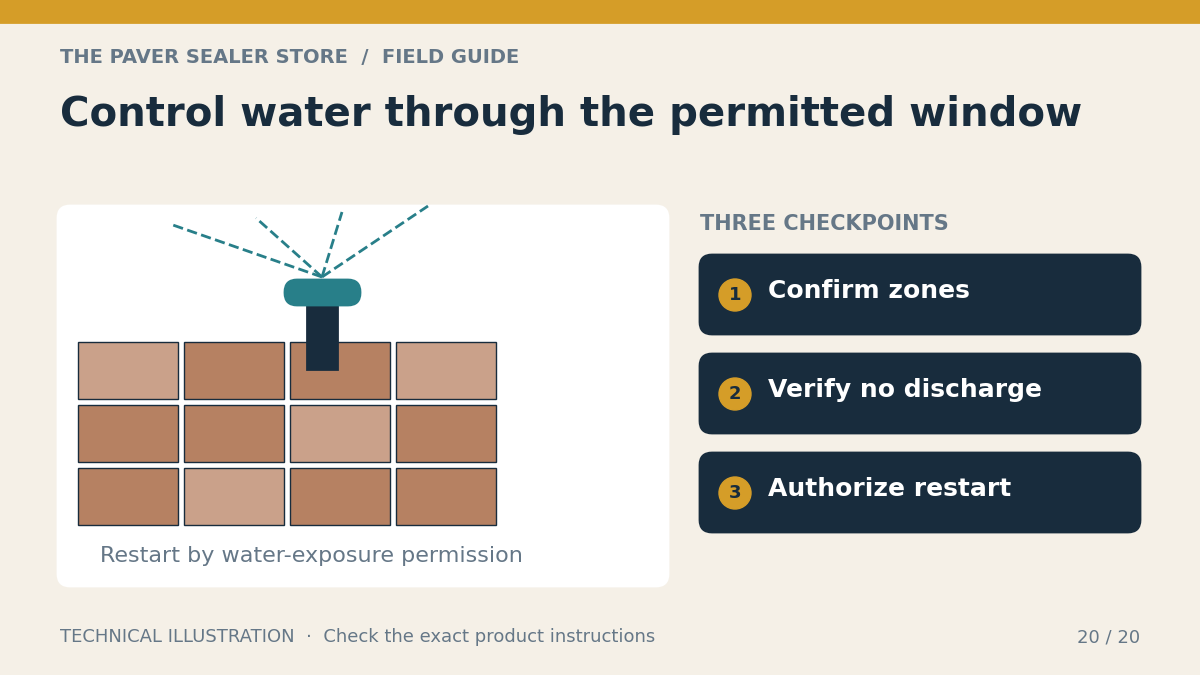
Turning off one sprinkler zone is not always enough to protect a sealing job. A controller may have several schedules, a remote app can start a cycle, a valve may leak and a neighboring zone may reach the paving. The useful plan names who controls irrigation, verifies the actual water sources and ties restart to the sealer’s permitted water-exposure conditions.
Map every source that reaches the paving
Walk the area with the owner or landscape contractor. Identify sprinkler reach, drip irrigation near borders, hose timers, leaks, water features and any neighboring system that crosses the work boundary. Note low areas where water remains after a cycle.
Do not use the zone name alone as proof of location. A label such as “front yard” may cover a planting bed and spray across the driveway. Observe the relevant operation before preparation when safe and suitable, and record which control actually stops the discharge.
Assign control responsibility
| Item | Record before work |
|---|---|
| Controller or app | Responsible owner and permitted change |
| Affected zones | Observed coverage and control identification |
| Other water sources | Hose timers, leaks and neighboring overspray |
| Protection window | Exact product requirements and current conditions |
| Restart authority | Who verifies readiness and who restarts watering |
Keep changes specific. A whole-property shutdown may affect plant care, while a partial shutdown may leave the paving exposed. Coordinate an acceptable plan with the person responsible for landscaping. Do not alter an unfamiliar controller or shared system without that coordination.
Verify the result at the surface
Check for leaking heads, dripping lines and continuing wet edges after the intended controls are changed. Confirm that scheduled or remote commands will not restart irrigation during the protected period. A screenshot of an “off” setting is helpful documentation, but the actual paving condition still needs inspection.
Complete the sealer’s required moisture and surface checks before application. If wet areas persist, investigate their source rather than assuming they will disappear during coating. Irrigation control does not resolve poor drainage or moisture entering from another part of the assembly.
Define restart by exposure permission
Use the exact product’s instructions for water exposure and curing conditions. Do not substitute its dry-to-touch or foot-traffic statement. These milestones answer different questions. Record application timing and the actual conditions needed for the restart decision.
There is no universal number of hours suitable for every sealer and project. If the instructions are unclear, obtain guidance from the supplier before scheduling the next watering cycle. Update the plan when application is delayed or when conditions differ from those assumed.
Manage an unexpected watering event
- Stop the water source through the responsible person.
- Document the affected area, exposure duration, product and time since application.
- Keep unnecessary traffic and improvised cleanup off the affected surface.
- Contact technical support for the product-specific inspection and correction sequence.
- Evaluate the result at the appropriate milestone before recoating.
Do not automatically roll more sealer across water marks. Early exposure can create different outcomes depending on product and condition, and additional coating can make diagnosis harder. Preserve evidence before deciding on repair.
Restart and inspect the coverage
After the permitted exposure conditions are met, have the responsible person restore the intended schedule. Observe the next suitable cycle for overspray, leaks and ponding. Correct ongoing exposure through irrigation or drainage work rather than treating repeated wetting as a reason to add more sealer.
Give the owner a clear record of the restored settings and the ongoing checks. The completed irrigation plan should protect the paving during cure and improve its maintenance afterward without leaving landscaping controls indefinitely changed.
Frequently asked questions
Can sprinklers restart when the sealer feels dry?
Not on that observation alone. Follow the exact product's water-exposure and curing requirements, which may differ from dry-to-touch instructions.
What should I do if sprinklers wet newly applied sealer?
Stop the source, document timing and conditions, and obtain product-specific guidance before cleaning, recoating or making a repair.
Related guides
- Landscape Lighting in Paver Areas: A Protection Plan for Cleaning and Sealing
- Fertilizer Granules on Sealed Pavers: Prevent and Diagnose Rust-Colored Spots
- Dry-to-touch and traffic milestones
Get help with the exact surface and product
Share the surface type, existing sealer, product information and clear photographs with Paver Sealer Store. Call 813-308-9202 for help matching your preparation or sealing plan to the actual installation.