Part of the How to Seal Patio Pavers guide.
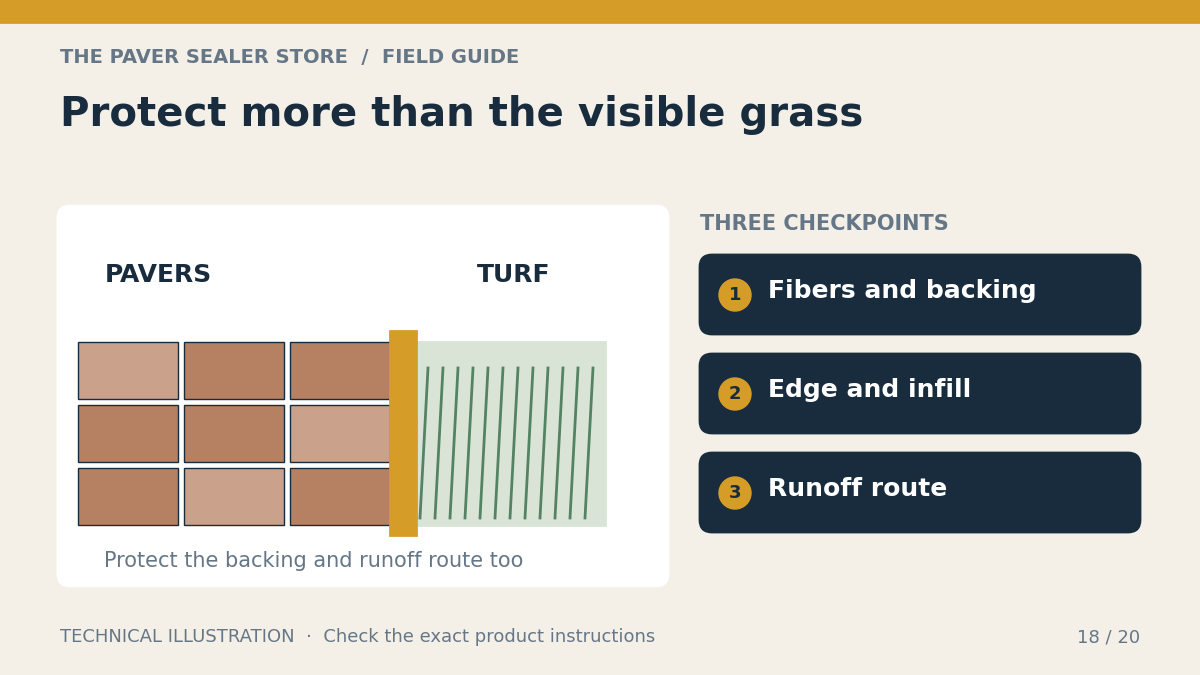
Pavers and artificial turf often meet at a narrow border or repeat across a stepping-stone pattern. That interface makes sealing more difficult than treating an open patio. Protecting the green fibers alone is not enough: the turf backing, infill, adhesive, edge restraint and drainage path can also be exposed to cleaner or sealer.
Identify the turf assembly
Ask the installer or manufacturer for the turf product and care guidance. Document whether the edge is mechanically secured, adhered or tucked around the paving. Note the type of infill where known and identify any drainage openings. Do not assume a cleaner compatible with concrete is compatible with the complete turf system.
Avoid pulling up the edge as an improvised masking step. Disturbing anchoring or infill can introduce a separate repair. If temporary removal is necessary, coordinate it with a qualified installer and preserve the intended reinstatement method.
Choose containment before choosing application speed
Inspect how treatment and rinse water could move beneath the border. A sheet over the fibers may still allow liquid to flow underneath or collect at the backing. Plan the direction of cleaning, recovery and coating before staging equipment.
| Interface element | Protection question |
|---|---|
| Fibers | Can overspray or treatment touch them? |
| Backing and adhesive | Can liquid flow underneath the visible edge? |
| Infill | Could cleaning displace or contaminate it? |
| Drainage opening | Will masking or coating obstruct the intended route? |
| Paver face | Can the approved system be applied without crossing the boundary? |
Use approved protection materials
Check that masking materials and adhesives are appropriate for the surfaces they contact. Test removal on a suitable inconspicuous area when needed. Avoid bonding tape to fibers or an unknown finish merely because it provides a quick visual barrier.
Keep protection secure without covering essential drainage or creating a trip hazard for the work route. Include a way to inspect the boundary during cleaning and coating. Protection that hides the edge completely can also hide a leak until it reaches a larger turf area.
Test the actual narrow transition
Use a representative section containing the paver edge and adjacent turf. Confirm that the approved preparation method stays contained and that recovered residue does not enter the turf. Test the permitted coating method at the edge, including how material is managed in chamfers and joints.
If a product-approved brush or roller method allows better containment, incorporate it into the tested application plan. Do not substitute an unapproved product or build a heavy edge film to compensate for a difficult boundary. A narrow strip can still be overapplied.
Respond to accidental contact immediately
Stop the source, document the product and ask the turf and coating suppliers for a compatible cleanup method. Do not attack fibers with a solvent or pressure-washer nozzle based on a guess. A treatment that removes sealer from concrete may be unsuitable for turf components.
Keep any cleanup trial localized and inspect the whole exposed assembly. A clean-looking fiber surface does not establish that the backing, adhesive or infill is unaffected. Coordinate repair with the turf installer if the interface has been disturbed.
Inspect before removing the protection
Follow the masking and coating instructions for removal timing. Keep contaminated coverings from dragging over fresh sealer or clean turf. Inspect the edge, drainage route and any displaced infill, then document the finished termination after the required evaluation period.
Give the owner a care note showing where coating ends. Future turf cleaning, pesticide treatment or paver resealing should respect that boundary instead of assuming both surfaces share one chemical tolerance.
Frequently asked questions
Is covering the artificial-grass fibers enough protection?
Not necessarily. Account for backing, adhesives, infill, edge anchoring and liquid routes beneath the visible border.
Can I remove sealer from turf with the same solvent used on concrete?
Do not assume compatibility. Stop and obtain guidance from the turf and sealer suppliers before a localized cleanup trial.
Related guides
- Landscape Lighting in Paver Areas: A Protection Plan for Cleaning and Sealing
- Irrigation and Paver Sealing: Plan Shutdown, Verification and Restart
- Wind and overspray protection
Get help with the exact surface and product
Share the surface type, existing sealer, product information and clear photographs with Paver Sealer Store. Call 813-308-9202 for help matching your preparation or sealing plan to the actual installation.